Ep. 99 The Life of an AgCredit Intern
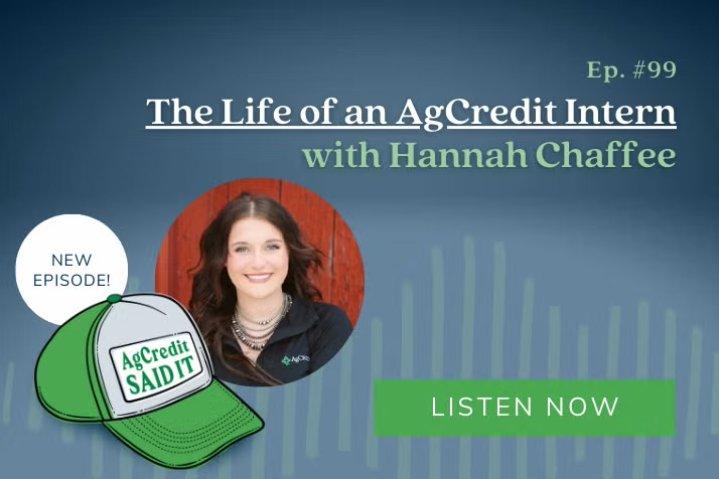
In this episode of AgCredit Said It, host Kayla Laubacher is joined by Hannah Chaffee, a marketing intern at AgCredit, to discuss her experiences in agriculture and marketing. Hannah shares her journey of starting a goat breeding business, FC Show Goats, which began with two goats gifted to her on her fifth birthday. She talks about the challenges and rewards of managing a goat farm, including the importance of quality over quantity and the significance of record-keeping. Hannah also discusses her rebranding efforts, emphasizing the importance of authentic storytelling in agriculture and how her education in agricultural communications has influenced her approach to marketing. Additionally, she shares insights on balancing her college studies with her business and internship, highlighting the value of networking and time management. The episode concludes with Hannah providing advice for aspiring entrepreneurs and sharing her social media handles for those interested in following her journey.
Connect with AgCredit on Facebook, Twitter and Instagram
Share questions and topic ideas with us:
Email podcast@agcredit.net
- Transcript
Speaker 1 (00:08):Welcome to AgCredit Said It, your go- to podcast for insights on farm finance and maximizing your return on investment. Join us as we talk to industry leaders, financial experts, and area farmers, bringing you skillful advice and strategies to grow your farm's financial future. AgCredit Said It, where Farm Finance goes beyond the balance sheet.
Kayla Laubacher (00:38):Welcome back to AgCredit Said it, where we take you beyond the balance sheet of farm finance. I'm your host, Kayla Laubacher, marketing specialist at AgCredit, and today we are joined by another member of the marketing team, our current marketing intern, Hannah Chaffee. Hannah has been with us since May 2025 and has been a great addition to our team this year. She is very creative, a talented graphic designer, passionate about agriculture, and just fun to work with. Hannah is a bit of an entrepreneur and really great at understanding the concept of branding. So we wanted to bring her on the podcast and let her share some of her experience working at AgCredit, running her goat breeding business, and being a college student. So welcome, Hannah.
Hannah Chaffee (01:15):Hi, everyone. Thank you so much for having me. I'm really excited to be here and would love to answer some questions for you.
Kayla Laubacher (01:23):Like I said, we are going to start with Hannah talking about her goat breeding business and then a little bit about marketing and branding, and then finish up with a little bit about you telling us about your college experience. And you are currently a student at Ohio State studying ag business and minoring in ag communications, correct? Yep. Yep. So perfect combination to be the intern here at AgCredit. So let's dive right into the goat part of it all. I don't know if I ever told you this. I used to show goats back in my day when I was in the county fair. That was my livestock.
(01:53):I wasn't very good at it. But can you share how you first got interested in goats and what inspired you to start your own breeding and showing business?
Hannah Chaffee (02:03):Absolutely. So first starting off is a funny story actually. On my fifth birthday, a family friend dropped off two goats at my front doorstep. My parents were not very happy about that, but I soon became in love with them and we had a great bond until they unfortunately passed. And then when I was in 4-H my first year, I decided I wanted to take a market goat. And then that was really sad because after they passed, because they were market goats, I had an empty barn again. So funny enough, a full blood reputable breeder in Senegal County was selling all of her goats and they were all papered full blood and great goats for a reasonable cost. So I did some sweet talking to my grandparents and they gave me a little loan and we got four goats, four mamas, and I've always been competitive.
(03:02):So the fact that they were show goats was just perfect for me. And that's kind of how it all started. And it went from four and multiplied pretty fast.
Kayla Laubacher (03:11):How many do you have now? Do you know?
Hannah Chaffee (03:14):Well, counting, we have donors, which is the actual goat. And then we flush those and we have receps. But we only have about 20 donors. So about 50 goats-ish.
Kayla Laubacher (03:25):Gotcha.
Hannah Chaffee (03:26):But we've kidded a little bit, but kidding will really start next month and then multiply pretty quickly.
Kayla Laubacher (03:35):Gotcha. So you have about some busy months coming up here for you.
Hannah Chaffee (03:38):Absolutely.
Kayla Laubacher (03:40):So can you tell us, I know your days are kind of different now since you're out of school, but in the summer, I know in the summer you always had interesting stories coming in to work every day of what you did before you even came into the office. So can you tell us a little bit about a typical day working with your goats, what that looks like?
Hannah Chaffee (03:56):Absolutely. Goats are funny. There's never a day that's the same is what I love to say. Something that I'm always doing is I'm always feeding twice or three times a day, healthcare checks twice a day because they love to get sick in a day. Definitely marketing and record keeping, obviously. And just the fact of in the fall and in the winter, it's a lot of kitting-based, like making sure they're healthy, they're eating enough and they're ready to kid. And then weaning those before, when that time is right, obviously. And then in the spring, it's more about prep for the upcoming show season, and then summer's kind of where it hits. We're showing, we're marketing, we're selling. That's really the busy season for me. So definitely no days are the same. They love to change it up on you, but definitely being flexible and knowing that and being able to work with them is helpful.
Kayla Laubacher (05:00):So While you're at Ohio State, who's taking care of your goats for you back at home?
Hannah Chaffee (05:04):I do hire two people to help when needed. So when we're doing shots or we're doing cleaning pens, things like that, I hire help. My grandparents love to help. They say it keeps them young, so I let them help when they want, but it's mainly my parents and my little sister who's 16. So she takes a lot of the hard work out, the chores, the everyday work because she's my little sister and she loves to do it too.
Kayla Laubacher (05:32):Nice. That's good to have the family support back home there for you.
Hannah Chaffee (05:35):Absolutely. We call it a family farm. I'm the one that started it, but it's really a family ordeal that everyone has a say on what's going on.
Kayla Laubacher (05:43):Everyone's got a little part in there.
Hannah Chaffee (05:44):Yeah.
Kayla Laubacher (05:45):So what are some of the unique challenges and rewards of working with goats?
Hannah Chaffee (05:50):So challenges is no day is the same. It's always different. Goats don't have a schedule, so they don't know when I'm going to have a final exam or when I have to work or when I have a meeting. So that is definitely something that is challenging. And regardless of that though, the Blue Ribbons and the banners make it worth my while. Going to shows with ones that I've raised since birth and winning is a feeling that I can't even describe. It's one of my favorite things to do and I look forward to keep doing it.
Kayla Laubacher (06:27):Nice. It's good to see all your hard work pay off for sure.
Hannah Chaffee (06:29):Absolutely.
Kayla Laubacher (06:31):So I guess the next question, kind of follow up to that. Do you participate in any competitions or shows or where do you travel to for that and what's the experience like doing those shows?
Hannah Chaffee (06:42):Yeah, definitely our more competitive based livestock. So definitely selling to families that love to show them. And then also my siblings and cousins, they all love to do it as well. So we sell anywhere from county to national level. So I sell to the county fairs around us in Northern Ohio. So we have county fairs that I go and help the ones that I've sold. We do our main focus as our AGBA, which is the American War Goat Association sanction shows because when we show there, we not only get blue ribbons and things like that, but we get points which go towards ennoblements and those annoblements make the pedigrees better and the dough or buck themselves more valuable. So we really try and hit a lot of those shows over just like jackpot shows that commercial goats go to. We also go to state fairs.
(07:44):I went to Ohio State Fair this year and this coming year we're looking to go to multiple fairs for the state level. And then we also go to national shows, which this year it was in Louisville, Kentucky. Next year we'll be in Nebraska. And yeah, the HBA sanction shows that we really focus on, those can be anywhere from any state really, but we really like going to those shows because it really shows you what livestock is in, what trends are in, and it shows you if what your stock that you have in Ohio is competitive to what stocks in Iowa or things like that. And it really helps to network because you're networking with individuals that are all over the country and not just in Ohio.
Kayla Laubacher (08:38):Yeah. Well, it sounds like you have a busy year ahead then with some of these shows a little bit farther away too. That's the goal.
Hannah Chaffee (08:43):I love to travel. So if I don't get to do a lot of vacationing because I am showing goats.
Kayla Laubacher (08:49):That's your vacation, right?
Hannah Chaffee (08:51):If I could vacation and show goats, that'd be perfect.
Kayla Laubacher (08:55):Is there a typical season of the year that's like show season or are they kind of all throughout the whole year? I know the fairs are obviously in the summer. Yeah.
Hannah Chaffee (09:02):Fairs are definitely in the summer, so state fairs and things like that. But nationals actually start in June and you have spring shows too, but less numbers usually than in the summer. And I showed all the way up until mid-October this year. So definitely a big chunk of the year.
Kayla Laubacher (09:22):Yeah. It's kind of convenient because it sounds like it's mostly though outside of your school year mostly. Some of it's overlaps, but it's a little bit more in the summer, springtime.
Hannah Chaffee (09:32):Yeah, absolutely.
Kayla Laubacher (09:34):How has your business grown or changed since you started it?
Hannah Chaffee (09:38):It has definitely changed from just having two goats dropped to my doorstep to having as much as I have now. Even from when we started breeding, the biggest change I would say is our intent. We do everything with intention now, whereas when we first started, there was no intention. We just kind of threw whatever we had in with the dough or we just kind of hoped for the best where now I really focus on genetics and record keeping and everything has a purpose and there's a lot of thought behind everything that we do and that really helps the outcome. I started doing more research into Bucks and Seemen and things like that that I didn't in years before and I've seen a dramatic change in the offspring. So that is definitely one of the biggest ways that our FC Showgoats has changed.
Kayla Laubacher (10:32):Nice. What advice would you give to someone interested in starting a livestock related business?
Hannah Chaffee (10:39):My biggest advice is to start small. Really focus on quality over quantity because if you have quantity, you're going to get burnout really, really fast. Whereas if you have the quality, you can always work to having more. And another thing that I have learned in my time is to always keep good records. Even if you think that the records are kind of pointless to keep, whether that be money or in just general healthcare, you might need it down the road and just to make sure that you keep those tracks. Another thing is just to learn from others because their input is really priceless. So I'm a part of Facebook groups that help educate others, seminars. There was a GOAT seminar at Farm Science Review last year, just things to help educate you and just don't be afraid to ask questions because it's really an industry that's constantly changing.
(11:37):And if you don't ask questions, you're kind of just going to be stuck.
Kayla Laubacher (11:41):Yeah. Nice. And we didn't say this at the beginning, I don't think. What is the name of your co-business? We should start with that.
Hannah Chaffee (11:47):I'll probably get into it more when we go into the branding aspect. It was Bern Creek Farm Board Goats, and that's how it is. Most people know us, but we just recently rebranded it and now it's FC Show Goats.
Kayla Laubacher (12:02):Okay, nice. Yeah. So well, switching gears, that lead us right into our next section on branding. So like I said before, Hannah's very talented at graphic design. She really understands the concept of branding. You don't know it, but you've seen a lot of her work for AgCredit on our social medias. We're redesigning some of our print materials and a lot of print ads and stuff that's coming out here in 2026 that you won't know it, but behind the scenes we know Hannah had a big hand in helping us do some of that design work. So why do you think that branding is so important for small businesses, especially in agriculture?
Hannah Chaffee (12:34):Going to the Ohio State University and in my agricultural communications class, we really focus and learn a lot about our purpose in branding and marketing. And I think that's the most important part when you're trying to figure out your small business is to just be authentic in your story. Tell your story because the thing about agriculture is it's personal. You know someone who knows someone, everyone knows everyone in agriculture, especially in Ohio and even in the surrounding states. So just to make sure that your story is authentic and you're sharing that story because your people that you might be selling to or networking with, they want to know who you are, what you stand for, and why you are different than your competitors or just you're different in general. So that's definitely something that has surfaced this year as I'm learning more about agricultural communications and knowing these things and always seeing them, but really never understanding purpose.
Kayla Laubacher (13:34):Yeah, branding is so important, like you said, and telling your story, I feel like that's what's preached so much in agriculture is just share your story because everybody is unique and people that aren't in agriculture don't know what they don't know. So what you think we're doing is boring, but it's interesting to somebody else and you can learn a lot and share a lot.
Hannah Chaffee (13:52):Yeah, absolutely, Kayla.
Kayla Laubacher (13:54):And so you talked a little bit or kind of started talking about how you rebranded your goat business this year. So can you walk us through your process for developing your new brand and why you decided to change it?
Hannah Chaffee (14:03):Yeah, absolutely. So I started this when I was 12 years old. So the name, not really a lot of ... There was a thought put into it, but not really for branding purposes. The Fern Creek came from, my great-grandma actually gave us her land. Her name was Fern, so that's where Fern comes from. And Creek comes from, well, we couldn't put our pasture all the way to the end of the property line because there was a creek there. So that's kind of how Fern Creek came about. And it was really adorable when I was 12 years old, but not really now when I'm trying to brand this really long name, Fern Creek Farm Board Goats. It's kind of a mouthful. It doesn't really help a lot for branding purposes. So recently this year, I was taking an agricultural communications class and learning so much through Ag Credit.
(14:53):And I was like, "You know what? I'm going to rebrand my whole farm." So it's not FCFG anymore. It's FC, Fern Creek, the letters, FC Show Goats because we don't really have ... It's not just goats, it's show goats. So this really just focuses on the simplicity and it's easy to remember. FC is a lot easier to remember than Fern Creek Farm Board goats. So we rebranded everything, got new merchandise, made. All of the print materials for sales and stuff are changed and all of the colors are like a salmon color pink because that's what my sister and my mother wanted. So it's all professional and it's a little girly, but it's us girls that do a lot of the work, so it can be. And I really like now that this branding has made it way more professional, even though it is a small business and it is a family business, it makes us way more professional when we go to shows or events because we do have all of this nice branding materials.
(15:55):And it really does make a difference when you're networking. People really do recognize you more often and it's very eye catching.
Kayla Laubacher (16:04):Yeah. And it is really pretty. I remember you showing it to me over the summer and I was like, oh my gosh, I love it. I love the Salmon Pink accent. And Hannah actually gifted me one of the hats that they had embroidered with a new logo on it for Christmas, and I cannot wait to wear it this summer. It's so cute.
Hannah Chaffee (16:17):Thank you.
Kayla Laubacher (16:18):So how has your experience as AgCredit's marketing intern influenced the way you approach marketing for your own business? Hopefully you've learned something from us over the past few months.
Hannah Chaffee (16:27):It definitely has learned a lot if anyone wonders. Definitely it's been a huge influence, not only Kayla, but the people that I've been surrounded with, whether it be at county fairs or just the workers, the lenders, the members, I get to do a lot of traveling in my internship, which I really appreciated and realizing that I do have a very unique story and to tell that has been really helpful. I did get a little nervous about putting my life out there and Kayla and Kelsey really helped me to learn that it's really okay and really talked me into posting more often. I need to get better at it, but I have been trying. And just realizing that the passion, everyone has a shared passion and it's just important to share that as much as it is to share the product itself. So it's definitely helped me a lot, this internship.
Kayla Laubacher (17:23):Good. Glad to hear that. I didn't pay her to say this. No, but no, posting on social media, I feel like people think it's like, "Oh yeah, just go post on social. It's so easy." But there's a lot of thought and time that goes into creating content for socials and it takes some time, definitely. Yeah.
Hannah Chaffee (17:38):And I know if it's wrong or if I mess up something, I'll have 20 calls. So it's just a lot of anxiety a little bit, making sure everything's right. But my mother is wonderful at checking. She's a teacher, so she likes to check my work.
Kayla Laubacher (17:53):That's good. What marketing strategies have worked best for you in marketing your business?
Hannah Chaffee (17:59):I've done a lot of marketing for AgCredit, and I can confidently say the reels have been very beneficial for me with a focus on Facebook and Instagram because those are where, not only for ad credit, but for my business, that's where my potential buyers probably are going to see my content. And on the New Year's resolution, I want to get better at TikTok for my Goat page, but definitely just being more consistent with posting with social medias has had way more views and outreach than any other marketing strategy ever. So it's just crazy to see the insights and knowing that the content that I'm making is actually being seen. So definitely that.
Kayla Laubacher (18:46):I think the thing that helps with social media or digital marketing stuff is just that you can see those insights. You can literally see how many people saw your posts, who interacted with it, where they saw it, and just it shows you all of those metrics so then you can dive in a little deeper and target those areas for the next time.
Hannah Chaffee (19:01):Absolutely.
Kayla Laubacher (19:03):Are there any tools, platforms, or resources you'd recommend to other small business owners for marketing or branding?
Hannah Chaffee (19:08):For marketing and branding, I have to say Canva. It is cheap, it's easy, and it's the most bang for your buck, if I'm being completely honest. I've tried so many branding websites and platforms and apps to try and help me. And Canva has just been the most helpful, whether it's videos, photos, just quick little edits I need to make, even just a little mock-up of something I need to print. It's really helpful and it's easy. There's templates to help someone that's starting out. You can use AI to help you make this template your brand logo and your designs. And I would definitely encourage anyone that hasn't tried Canva and they're struggling with their branding and their marketing to try because it wouldn't hurt to try and they do have free versions. And then for the other side of things, more like my business major related stuff, definitely Excel and Google Sheets.
(20:12):When you're looking into your budgeting and your costs and your incomes, you really need to have Excel and your sheets because if you're not keeping records of your credits and your debits, it can get really confusing really fast. So definitely just using those templates that are available and making sure that you are putting all of your records. I did have to recently put all of my records from paper into the computer and it was time consuming, but I really wish I would've just used the computer to start with.
Kayla Laubacher (20:46):Yeah. It makes it a lot easier to keep track of. I'm in that boat with some of my farm record keeping too. I'm like, I should really not do this. I should use a computer or something, not just do it all by hand. But yeah, I would say Canva, it's C-A-N-V-A, Canva. And we'll put a link to that in the show notes for anyone that wants to, because I would totally agree with you. That is such a good tool. Like you said, there's a free version, but if you're not great at design, it's so easy to use and very user-friendly. So definitely check that out for social posts, flyers. I think you can even draft websites in it. It's crazy the amount of things you can do in Canva.
Hannah Chaffee (21:20):And you can schedule in Canva, which I just learned how to do and it's great. So if I have a test or I'm working during these hours and I can schedule a post through Canva directly to my Instagram or to my Facebook and I don't have to do the extra saving and putting captions and everything and it just does it for me. So that's definitely helpful.
Kayla Laubacher (21:40):Yeah. I haven't tried that using that yet. So I'll have to look into that as well. Can you share a success story where branding or marketing made a difference for your business?
Hannah Chaffee (21:50):Absolutely. I was doing sale photos for a friend of mine and for myself. And both of those pictures that I took were so helpful when it came to putting them out there. When you have high quality photos, it just had so much traction and the amount of views that I got on Facebook that I've never gotten before, it was unbelievable. So definitely glad I bought a camera and really practice angles where it comes to livestock and really showing that the sale pictures, the good quality pictures are helpful and it's not just a waste of time.
Kayla Laubacher (22:30):Yeah, they make a difference. Yeah. What mistakes or lessons learned could help other entrepreneurs avoid common pitfalls that maybe you've experienced through your business or through marketing?
Hannah Chaffee (22:41):It's hard to start, but if you never start, then you can never go anywhere. And I think that's one of the biggest lessons that I've learned and that could help other entrepreneurs that are starting out or that are kind of in a rut.
Kayla Laubacher (22:53):I've always heard messy action is better than no action. Just start and you can iron things out as you go and get things to where you want them to be, but you got to start somewhere, right?
Hannah Chaffee (23:03):Yep.
Kayla Laubacher (23:04):All right. So shifting gears again a little bit, we're going to now talk a little bit about your college life and your college experience and balancing all these things that you've told us about so far with being a student full-time as well. I know we said this at the beginning, but can you tell us again what you're studying and how does it relate to your business?
Hannah Chaffee (23:20):So I am a second year at the Ohio State University studying agribusiness and applied economics with a minor in agricultural communications. And I do have a focus on marketing. I love marketing. In my college experience, I'm trying my best to manage my time. I think I do a good job at it, but definitely some room for improvement. I relate to business and this, it's clear as day. It all lines up and it's actually kind of crazy how everything I'm learning in the classroom, whether it's communications or if it's agribusiness and econ, everything that I'm doing kind of lines up and it's actually kind of a little bit crazy. I did not know it would when I first chose this major, but it's a great surprise. Marketing and the numbers, everything, it always helps and it helps a ton. So I think that's the best way to answer that.
Kayla Laubacher (24:17):Yeah. So how do you manage your time between classes working at AgCredit and running your own business? Do you have any tips or tricks on time management to get everything done?
Hannah Chaffee (24:27):Yeah. So I plan ahead. I plan in blocks. So if I have morning classes, I know that I'll work in the evening or if I have evening classes, I know that I'll work in the morning, just things like that to block out time. I always block out time to kind of be a little creative for my own business too. And just having that time management skills, knowing that if you have class, just knowing that if these breaks in time to be productive and then also taking time for yourself. But at the end of the day, being flexible because things do come up. And if I have an exam, I know exactly that I'll tell Kayla that I have an exam and it's really nice to have bosses and people in my life that if I say that too, they understand and are flexible with me as well because at the end of the day, the school and my grades come first.
Kayla Laubacher (25:22):Yeah, definitely. We're always pretty flexible with the schedule and you're very good at communicating. And I think that's a big piece of it is like you communicate with us when you're going to be available, when you'll be online. And we try to communicate if there's projects we give you that have specific deadlines or anything like that, that way you can manage that to get things done when needed.
Hannah Chaffee (25:41):Yeah. Deadlines are a big deal too. Just getting done what I can get done before. So if something comes up after, I'm not rushed on a project and this and that. So it's getting done what I can do in classes where if I'm given projects to get projects done in the beginning instead of the end and just kind of managing my time. So if I do have to run home for something, it's manageable.
Kayla Laubacher (26:05):Yeah. Nice. Have you been involved in any campus organizations or agriculture groups?
Hannah Chaffee (26:11):Yeah, I am happy to say that I am involved in quite a few clubs and organizations. Some of those include Agribusiness Club. I'm in Collegiate Farm Bureau, the Saddle and Sirloin Club. I'm an officer in Agricultural Systems Management Club. I do all of their graphics. I volunteer a lot in Columbus. I'm a career ambassador for CFAS, which if you don't know, that's the College of Food and Ag for Ohio State. And I'm also in Collegiate 4-H and Meat Science Club.
Kayla Laubacher (26:48):You're a busy girl. So from all of those different things that you are involved in, what do you find the most rewarding and the most challenging about juggling all these responsibilities, all these clubs, all these things you do?
Hannah Chaffee (27:01):Yeah. The most rewarding part is that seeing the connection. So all of these things are connected and knowing that the people that I'm working with in school, I'm probably going to work with later down the road. So just knowing that all of these, although it is challenging and it's hard to juggle sometimes that at the end I can see the connection and also just knowing that it's kind of like a pat on the back that I can do this and it's just like I can.
Kayla Laubacher (27:38):Yeah, you figure it out. But yeah, like you said, you are going to be connected to some of these people forever. It's crazy how that works out in life, especially in agriculture because the agriculture world really isn't that big. So you definitely will cross paths with so many of these people that you're meeting and connecting and networking with now throughout your whole life and career.
Hannah Chaffee (27:56):Yeah. It's already happening not only through AgCredit, but through scholarship dinners at Ohio State, just connecting ag credit to that and this. And it's just all of the lions connect at the end of the day. So it's nice that I kind of got a little of a head start.
Kayla Laubacher (28:12):Nice. So do you have any tips for other students looking to start a business while in college? I know you started yours well before college, but if someone maybe your age now wants to start their own business or do something like that, do you have any advice for them?
Hannah Chaffee (28:25):Yeah. Actually, I do have a few friends that are in the midst of starting their own businesses and one piece of advice that I give all of them is just start with something you're passionate about because at the end of the day, if you're passionate about it, it's not going to feel like work. It's not going to feel like a hobby. It's going to feel fun. And I think that that is the most important thing when you are starting a business or you're wanting to start something like that, whether it's entrepreneurship or a new job or anything, just make sure it's something you're passionate about. And honestly, when you're passionate about something, the rest of everything else falls in place. So that's some advice from someone who has done it for a while. I didn't just start, but sometimes it feels like I just started.
Kayla Laubacher (29:12):Yeah. No, that's great advice. If you're not passionate about something, it'll feel so forced and feel like so much work. So no, I love that. All right. So we're about to wrap it up here, Hannah. I have two last questions for you. First, you've given us a lot of advice already, but what is the best piece of advice you've ever received?
Hannah Chaffee (29:29):The best piece of advice I've ever received is at school, my boss told me, "It's not what you know, it's who you know, so keep connecting." And that has really stuck with me.
Kayla Laubacher (29:40):And that literally fits into what we just were saying too, how all this stuff, but the networking is so important. Yep, so that's great. And so lastly, where can listeners find you on social media if they want to follow along or learn more about your business? Where's the best place for them to find you?
Hannah Chaffee (29:55):Yeah. On Facebook, it's FCShowGoats on Instagram FC Showgoats. Also, my personal is Chaffee Hannah on Instagram and Hannah Chaffee on Facebook. And the TikTok is coming soon.
Kayla Laubacher (30:11):Nice. We'll keep an eye out for that.
Hannah Chaffee (30:13):Yeah.
Kayla Laubacher (30:13):Awesome. Well, thank you, Hannah, so much for joining us today and for all the work you've done for us here at AgCredit. It was fun for me too. I've worked with you for many months, but just still to learn a little bit more about all the things you do and all the things that you've been involved with. And to our listeners, thank you for tuning into another episode of AgCredit Said it. We'll talk to you next time, which will be actually our 100th episode of AgCredit Said it. So make sure you don't miss it. Talk to you then.
Speaker 1 (30:44):Thank you for listening to AgCredit Said it. Be sure to subscribe in your favorite podcast app or join us through our website at agcredit.net so you never miss an episode.